Generator Safety: The Part That Kills People
Portable generators produce carbon monoxide, a colorless, odorless gas. Never run a generator inside a house, garage, basement, or carport — even with doors and windows open. Run it outside, at least 20 feet from any door, window, or vent, with the exhaust pointed away from the home. Carbon monoxide poisoning from generators sends people to the hospital every major outage, and it's entirely preventable with correct placement. Install a battery-powered CO detector if you don't already have one.
Food Safety Timeline
Refrigerator: 4 Hours
A closed fridge keeps food safely cold for about 4 hours. Keep the door shut as much as possible — every open cuts into that window.
Full Freezer: 48 Hours
A full freezer holds temperature for about 48 hours (24 hours if half-full) as long as it stays closed. If it still has ice crystals or is 40°F or below when checked, it's safe to refreeze.
When in Doubt, Throw It Out
Perishables left above 40°F for more than 2 hours should be discarded. A cheap appliance thermometer removes the guesswork — don't rely on how the food looks or smells.
Conserving Your Phone Battery
Enable Low Power Mode
Cuts background activity and can meaningfully extend battery life. Lower your screen brightness too — the display is one of the biggest battery drains.
Limit Non-Essential Apps
Close apps you don't need for updates or safety. Keep your weather and emergency alert apps running — that's what matters.
Prioritize a Car Charger or Power Bank
A car charger turns your vehicle into a power source (run it in a well-ventilated area, never in a closed garage). A charged power bank should already be part of your emergency kit.
Other Outage Basics
Unplug or turn off major appliances to prevent a power surge from damaging them when electricity returns — leave one light switched on so you know when it's back. Treat every downed power line as live, and stay at least 35 feet away. Check on elderly neighbors and anyone dependent on powered medical equipment; they're at the highest risk during an extended outage.
Water Safety
A prolonged outage can affect municipal water systems, especially if flooding or storm damage compromised treatment or pumping stations — local authorities may issue a boil water advisory as a precaution. If one's in effect, boil tap water for at least one minute (three minutes at higher elevations) before drinking, cooking, or brushing teeth, or use bottled water instead. Keep an eye on local alerts for when the advisory is lifted; water can look and taste completely normal while still being unsafe.
Staying Warm or Cool Without Power
In winter, close off unused rooms to concentrate body heat in one space, and layer blankets rather than relying on a single space heater running off a generator. In summer, a battery-powered fan and staying on the lowest floor of the home (heat rises) can meaningfully reduce indoor temperature. In both cases, check on family members and neighbors who are elderly, very young, or medically vulnerable — they're the most at risk from extended exposure to extreme indoor temperatures during an outage.
Medical Equipment and Prescription Refrigeration
If anyone in the household relies on powered medical equipment — a CPAP machine, home oxygen concentrator, or powered wheelchair — register with your utility's medical baseline or priority-restoration program before an outage happens, not during one; most utilities offer this at no cost and it can mean faster restoration to that address. For refrigerated medications like insulin, a small cooler with ice packs can maintain safe temperature for many hours; check the specific medication's label or ask a pharmacist for its actual temperature tolerance window, since it varies by drug.
Frequently Asked Questions
How long do most storm-related power outages actually last?
Most last a few hours to a day, but major hurricanes, ice storms, or derecho events can knock out power for a week or more in the hardest-hit areas, which is why the 72-hour self-sufficiency standard exists as a baseline, not a guarantee.
Is it safe to run a generator in a garage with the door open?
No. An open garage door does not provide adequate ventilation — carbon monoxide can still accumulate to dangerous levels and drift into the attached home. Generators must run fully outdoors, away from doors, windows, and vents.
Should I call my utility to report an outage?
Yes, most utilities rely partly on customer reports to map outage extent, especially for damage away from major roads. Most also offer text or app-based reporting and restoration-time estimates.
Can a whole-home battery or solar backup replace a generator?
For shorter outages, often yes, and more quietly and safely (no carbon monoxide risk). For multi-day outages, capacity and recharge speed become the limiting factor, so many households use battery backup for critical loads and a generator as backup for longer events.
Know What's Coming Before the Power Goes
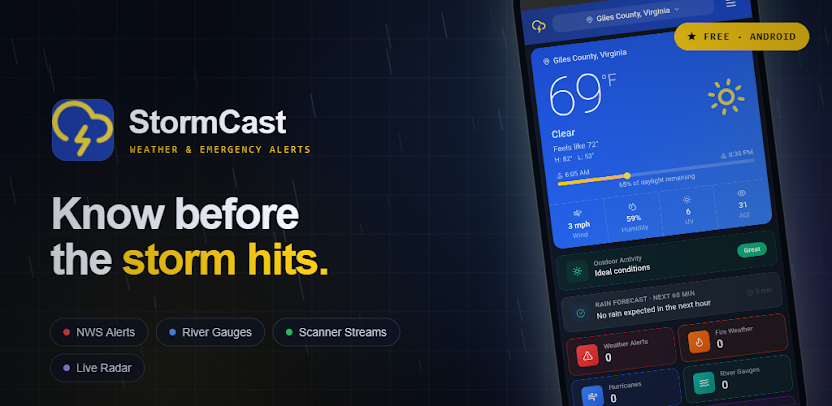
StormCast pushes severe weather alerts the moment they're issued for your location, so you have time to charge devices, fuel a generator, and prep the fridge before the outage — not after.

More from the Blog
A note on this guide: This is general safety information, not medical or professional emergency advice, and specific criteria can vary by region. In an actual emergency, call 911 and follow instructions from local officials and the National Weather Service.