How It Actually Works
NOAA Weather Radio All Hazards is a network of transmitters, run by NOAA, broadcasting continuous weather information on dedicated frequencies (162.400–162.550 MHz) separate from commercial radio. A basic receiver just plays the broadcast. A receiver with SAME (Specific Area Message Encoding) does more — it stays silent until a digital code matching your programmed county comes through, then triggers a loud alarm and unmutes automatically, even if you're asleep or the radio is in another room.
That SAME-based automatic alerting is the actual feature worth paying for — a radio without it is just a scanner you have to remember to check.
What to Look For When Buying One
SAME Alerting
Non-negotiable. Without it, you're relying on constantly monitoring a live broadcast, which defeats the point.
Battery Backup
Look for a unit that runs on batteries or has a hand-crank/solar option, not just AC power — a radio that dies with the grid is not much of a backup plan.
Alert-Type Filtering
Better units let you filter out lower-priority alerts (like a routine test) so you're not woken for everything — useful in areas where minor advisories are common.
The Situations Where It Still Wins
No Cell Signal
Rural areas, basements, and some mountainous terrain have dead zones for cell data. Weather radio transmitters have their own dedicated coverage footprint, independent of your carrier.
Power and Internet Are Both Down
A battery- or crank-powered weather radio keeps working when the grid and home Wi-Fi are both out — a phone on cellular data still works too, but a dead phone battery with no power to charge it does not.
Deep Sleep or Hearing Considerations
A weather radio's alarm tone is specifically designed to be loud and jarring enough to wake a sound sleeper. Some models pair with strobe lights or bed-shakers for people who are deaf or hard of hearing — a category of accessibility most phone apps don't fully replicate.
Setting One Up Correctly
A weather radio is only as useful as its programming. When you first set it up, use the SAME county code for where you actually are, not just your mailing address — codes are assigned per county (or independent city), and some counties span more than one NWS forecast office boundary. If you travel regularly between two counties — commuting to a job, visiting family — most SAME-capable radios let you program multiple codes so you're covered in both places. NOAA maintains a public county-code lookup on the National Weather Service website if you're not sure which code applies to you.
What It Costs
A basic SAME-capable weather radio runs roughly $25–$40. Battery-and-crank hybrid models with a flashlight and USB charging port run a bit more, typically $40–$60. Given how long a well-made one lasts and how rarely you actually need it, it's one of the cheaper pieces of insurance in a preparedness kit.
The History Behind the Network
The network's roots go back to the early 1950s, when the Weather Bureau began experimental VHF weather broadcasts for the aviation and boating communities. When NOAA was created in 1970, it inherited and expanded that VHF network under the NOAA Weather Radio name, and the "All Hazards" branding was added later once local emergency managers started using it to relay non-weather emergencies too — AMBER Alerts, chemical spills, and other civil emergencies, alongside severe weather. Today the network covers well over 95% of the US population through more than 1,000 transmitters, making it one of the oldest continuously operating public alerting systems in the country — predating cell phones, the internet, and cable news by decades.
Frequently Asked Questions
Do I need a special antenna to receive the signal?
Most consumer weather radios have a built-in antenna sufficient for typical suburban and rural reception. In fringe coverage areas or hilly terrain, an external antenna can meaningfully improve reception, similar to how a TV antenna works.
Can I listen to NOAA Weather Radio on my phone instead?
Not directly — it broadcasts on a dedicated VHF band your phone's radio hardware can't tune to. Some streaming apps rebroadcast the audio over the internet, but that defeats the core advantage: working without cell service or Wi-Fi.
Does weather radio cover hazards besides weather?
Yes — the "All Hazards" network also carries AMBER Alerts, national emergency messages, and, in some areas, non-weather civil emergency messages issued by local authorities, not just NWS weather products.
How do I know if my area has good coverage?
NOAA publishes coverage maps for the network online. Most populated areas of the US are covered, though some remote or mountainous regions have gaps — worth checking before assuming a radio will work reliably at your specific address.
The Honest Answer
For most people with a phone that stays charged and in reach, a weather app covers day-to-day needs better — radar, multi-location alerts, and context a radio simply doesn't provide. A weather radio earns its keep as backup redundancy, not a replacement. For a full side-by-side, see Weather Radio vs. Phone Alerts.
Get Instant Alerts on Your Phone
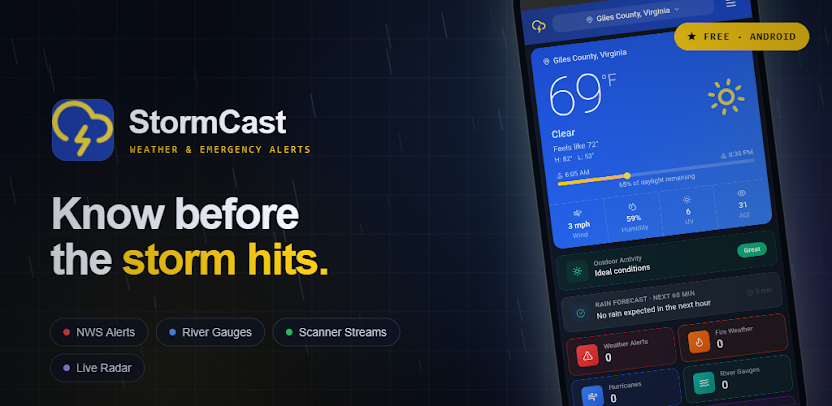
StormCast pushes warnings the moment they're issued for your location — free, with radar and river gauges the radio can't give you.

More from the Blog
A note on this guide: Thresholds and criteria described here are general and can vary by NWS forecast office, region, and over time. This content is educational — always check your local National Weather Service office for the specific criteria that apply to your area.